Living High on the Hog

I was looking for my recipe clipping for the very first biscuits and pancakes I made on my own. It is a small piece of brown paper cut from a Commodities flour bag. . Commodities were part of the USDA program to provide supplemental food to the elderly and  poor among others.

recipe 001

My grandmother was an elderly widow on a fixed income in the sixties. She would come and stay at our house for the summer or for several months. Along with her would come her USDA commodity food products. There would be flour, sugar, peanuts, peanut butter, powdered milk, and more. Lard was the fat to cook with back then, soon to be surpassed by Crisco and its ilk. What I remember about Grandma are the butterscotch hard candies she would pack in her suitcase, which I looked forward to getting slipped as a treat. I think I would just stare at the candies longingly being too shy and not wanting to ask for them directly. That was me even in my own family. Waiting on the edges to be acknowledged and provided for. I had a very loving family but I internalized a sense of modesty to the extent of waiting, not making demands, and never putting myself in the center of attention. (For those of you who know me I have changed, quite a bit, and am not the shy retiring girl I used to be.) But back to Grandma…

Grandma would cook with lard. There was no shame in frying up chicken or anything else for that matter and mashed potatoes were smothered with butter, or oleomargarine. She made the best biscuits ever. I have no idea what recipe she used; I’ll have to ask my sister. She has more knowledge about our family food history than I do. These biscuits were melt-in your-mouth tasty. Eggs would be fried and grease poured over them in the cooking. Grandma and my mom had a bit of weight on them. As they grew older and frailer in health they became thinner but one could always see the remnants of the belly and the round face. I have to watch out for this. I look in the mirror and sometimes see my mother’s face looking back at me. The belly is creeping up on me now too.

Lard is making a comeback into the kitchens of America. It is hog fat. It is processed to a degree but does not have to have trans fats. At least the pound I bought recently has 0% trans fats. It is not pure unprocessed “real” food because it has to be preserved in some way. The additives stabilize taste and texture. Shortening has always made a flakier pastry than butter but shortenings are out of favor. Butter seems to have gone out of favor too but hopefully is making a comeback. There are books that tout the healthier nature of butter to the “butter-like substances” filling the dairy shelves, and there are those who claim lard is healthier than butter. The idea came to me to make pie dough and to use lard. Actually I was watching a TV show on pies across America and one bakery featured used a combination of lard and butter and I liked that idea very much and wanted to try it. So I find a pound of lard for about the same cost as the pound of butter and bring it home. And what about biscuits? Perhaps Grandma’s were made with lard. Hmmmmmm?

ep2015 019

Which brings us to the other hog fat that is tasty, tasty, tasty, and which fragrance makes one’s mouth water: Bacon. And not just any bacon. Uncured bacon. Uncured bacon is processed in some fashion but not with the chemical additives so it is safer to eat. On my recent foray into the world of Trader Joe’s my husband and I looked hard and long at the meat. The price of uncured bacon is out of our normal budget but there was this package of ends and pieces. Hey, what the hey. I usually have found myself hacking off an inch or two from the bacon package to flavor dishes and not frying up slices. So this will be fine; I can hack off a chunk to use. I bring the entire frozen package camping. I can hack off a chunk and we can put it with our eggs in the morning. Labor Day weekend we are camping at our new found local private campground and cooking up our eggs in the cast iron skillet on the Coleman road trip grill. This is my husband’s fabulous new toy since the camping grill and the camp-stove blew up earlier this season!

ep2015 005The taste of this uncured bacon was heavenly. Umami: a pleasant savory taste. It fills the mouth. There is a lot of bacon grease that we poured into a tin camping cup and kept. Women used to keep the grease can on the back of the stove to reuse. And then I think: I have two small potatoes that I brought for hash browns and an onion. How about we cook these in the bacon grease? And we do.

I cut up two small potatoes into matchsticks. I dice one onion. We fry this up in the cast iron skillet, stirring, and then letting them get nice and crispy. Yum, yum!

ep2015 006ep2015 009

Now there’s a camp breakfast! Granted one cannot cook in fat all the time but every once in awhile, will it hurt?

Too Many Cookbooks

Yes, there is a something about having too many cookbooks. It is like taking a toddler into 31 Flavors of Ice Cream and asking her to pick one. At times there is a need for only chocolate-vanilla-strawberry.

To begin one knows one has too many clothes when the closet rod falls down. This happened to me recently. My husband went upstairs and when he came down he said to me “I like what you did to the closet.” What?! And when I went upstairs there it was. What to do? He fixed the rod. I put together outfits of clothes and put away some of the others. This was hard because some tops go with more than one bottom and vice versa. But I had been feeling like I had too many clothes because it was getting more difficult to decide what to wear each morning to work. Let’s be real. It was even hard to decide what to wear on the weekend, to church, and even what to take camping! Too many choices!

This is the same phenomenon with too many cookbooks. I have over 60 cookbooks and booklets in my kitchen. And more cookery books get published everyday. I have a fondness for the word “cookery”. But I digress. When I go to the library I inevitably come home with two, three or four new cookbooks to peruse. Very seldom but on occasion I decide I want one of those for myself and if I find it on-line at a decent price I will buy it. I am expecting one to be delivered any day now. What these library books sometimes do is send me back to the books in my cupboard. I compare and find recipes in the books I own that I would like to try. But while I have the library books I have to try the recipes in them. Or at least think about those recipes over and over until I return the books. What to do? tomato sauce 001Too many choices.

I was talking with my husband about this the other day after confessing that a cookbook would be coming in the mail soon. He used to work in the restaurant industry and told me that chefs had told him only three books are essential: The Professional Chef by the Cullinary Institute of America, LaRousse’s Gastronomique, and The Joy of Cooking. Even though I have all three of those I am thinking that the home cook might have different needs, although The Joy of Cooking could be considered a stand-alone basic needs book. Luckily my lovely family gave me the 1997 version so it is updated for modern appliances, etc. Bittman’s How to Cook Everything is an all-purpose, all encompassing guide which I use more frequently than Joy. I still have some of the Better Homes and Gardens collections and those use to be my go-to books. When I went away to college and got my own apartment, my mom gave me her Settlement Cookbook so I would have a guide to cooking meat and such. Most of my kitchen skills before that were for baking cakes, cookies, pies. Over the years of being a single parent  I also began using the Betty Crocker  cookbook my Aunt Betty gave me back in the 1970s. This was great for pancakes, some cookies, and “how to cook a turkey”.

So what cookbooks does the home cook need? A stand alone basic how to cook anything and everything with all the variations.  I would suggest Mark Bittman’s How to Cook Everything . Now if the home cook is a baker of breads, then a good bread book. I have several but the go-to was always the Fleishman’s bread book. I have the older paperback booklet type that has fallen apart but I have saved all the pages even though the cover has long been lost along with the index. My sister has the spiral bound one. But now I use the Soulard Market Pushcarts & Stalls for their River Mill Bread and Everyday Table Bread which both call for mixed wheat flours. (I went to get that cookbook to get the title correct and opened it to some vegetable recipes and got distracted by scalloped eggplant, marinated tomatoes and Soulard Vegetable Stew!)

Now with so many food sites on the internet, such as Allrecipes.com, does anyone need a cookbook at all? Well, some of us like to read cookbooks. Those are the books that provide a story or education on the food item to be cooked. I like the cookbooks that tell about how the writer or writers explore the world of food for whatever reason, environmental, health, lifestyle, weight loss, etc. Plus, I have found that it is of no use to me to get cookery books downloaded to my Kindle. Nope, cookbooks are meant to be hard copy, pages to flip back and forth, sections to underline and highlight, photos to compare and emulate, and the like. That is substance and so much pleasure!

I thought it would be a good plan to make note of what books provide the basic recipes that I use. But in thinking about this I find that I do not use that many basic recipes and if I do it is from thinking about ingredients and seldom do I ever follow a recipe verbatim. Some baking recipes, actually most, but not for salads, meat dishes, vegetables, pasta, etc. When I first got my food processor I made mayonnaise from its instruction booklet. When I got my waffle iron I made plain waffles from its instruction booklet. When my son gave me Julia Child’s The Art of French Cooking, I made beef bourguignon. Actually I made the Sauté de Boeuf de Bourguignon. I bought another coffee table size French cookbook and I make the Tart Citron from it. But for everyday food I may glance at a recipe for guidelines or ideas but don’t really follow exactly. This is usually because I don’t have all the ingredients on hand so I substitute something, or leave something out, or add all the variations instead of just one.

Which brings me to tomato sauce. Tomato sauce is one of those basic kitchen needs that everyone says is better made from fresh. I have never in all my years made homemade sauce from fresh tomatoes. I make a good homemade sauce from cans of crushed tomatoes in a variation of a recipe I found in Cook’s Illustrated. However, the farm market has such beautiful looking plum tomatoes that I buy them twice a week. This farm market is basically in my back yard in that it is two blocks away from my house. It is like having a garden without having to have worked it!

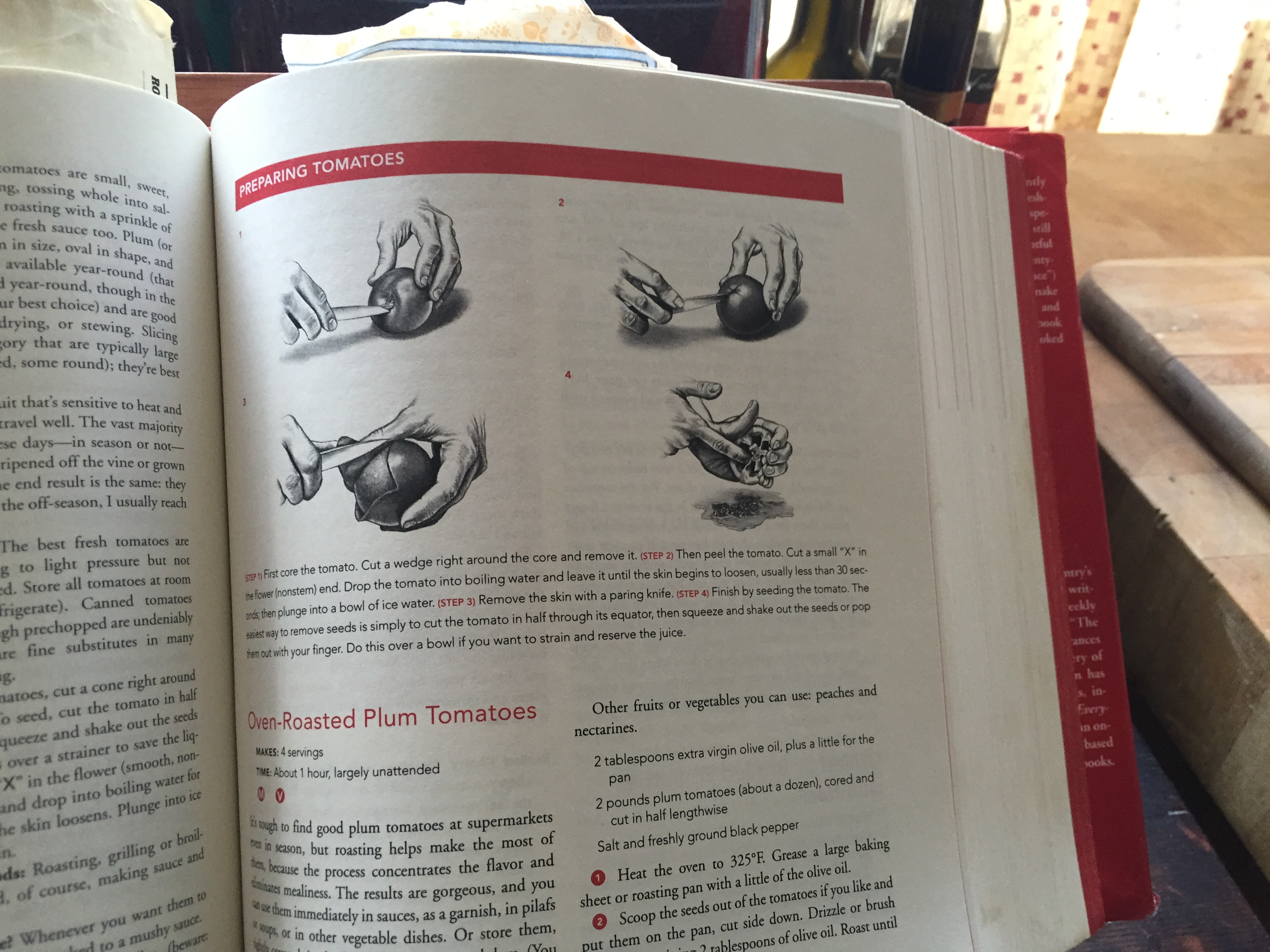
tomato sauce 003How to make sauce? I know that you have to peel the tomatoes. Not looking forward to that. But Bittman’s book has easy instructions. I have used the “drop in boiling water-remove from boiling water-plunge in cold water” to make a fresh peach pie somewhere in my past, so I can do this. Then I use his quick sauce recipe but add onion, garlic, and the basil at the end, not just one of those.

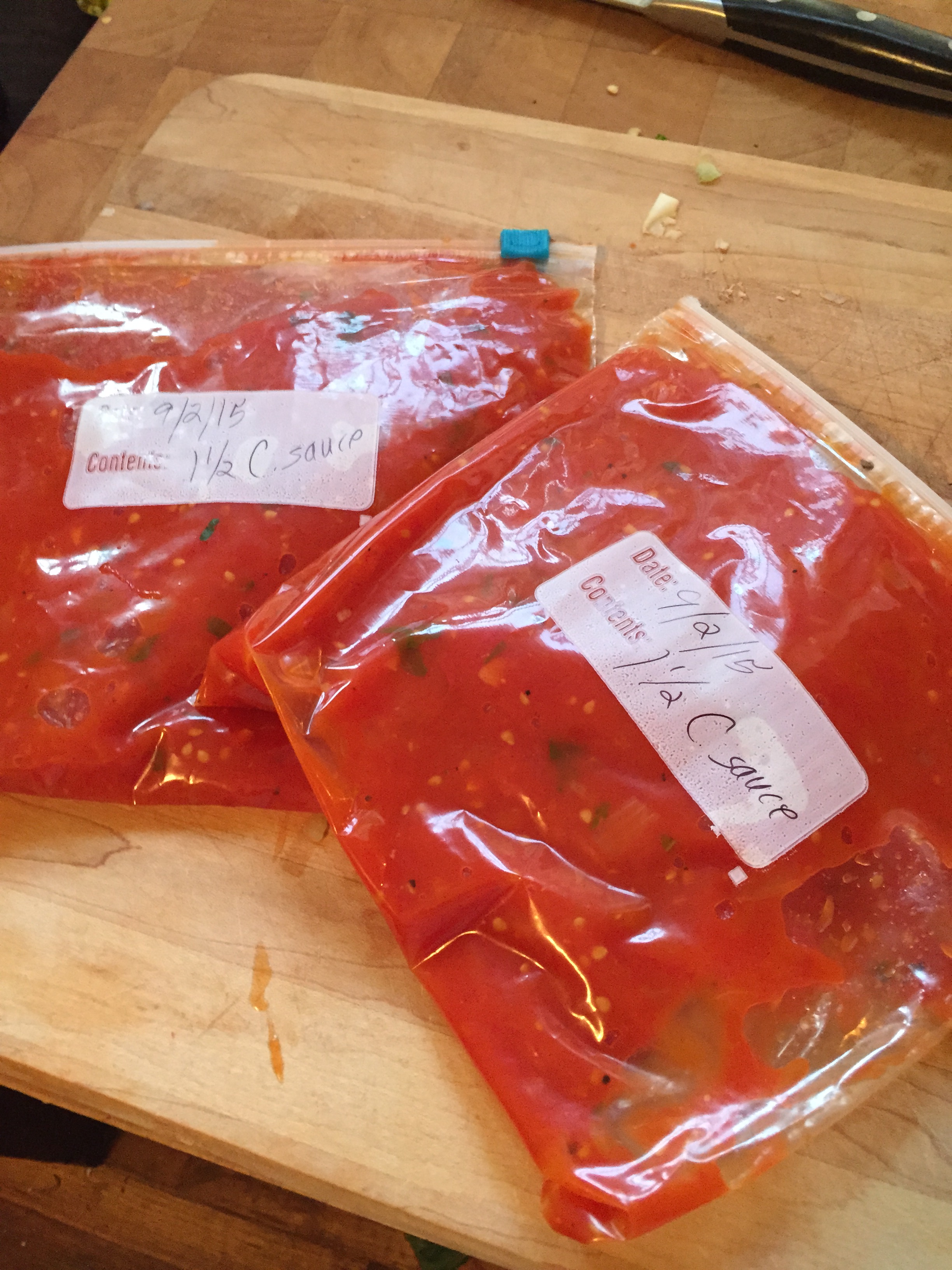
tomato sauce 006tomato sauce 007So I have made about 3 cups of sauce out of 4 pounds of tomatoes. It’s not pasta day so I freeze these for use sometime after tomato season.

tomato sauce 008In thinking about it now, I should have added the vegetables such as carrots and celery, maybe even peas and mushrooms, to simmer in the sauce but those will be added when the pasta dish is on the menu.

And what basic cookbooks do other people rely on?