Soupe a l’oignon a la Julia!

I have been enjoying cooking from my “French” cookbooks, one by Julia Child and one by Jacques Pepin. Hubby bought beef broth hoping for some onion soup. We get lots of onions each week so had all the ingredients. Hubby prefers beef broth as it gives a different taste and mouth feel.  I think that is umami.

I chose to go with Julia’s recipe from Mastering the Art of French Cooking. My goal is not to master the art but to experiment with different combinations and ways of preparing food. I really like soups. Hubby likes soups to be more stew-like.  I have adjusted very few items in this recipe. I use slightly less butter than she suggests. This is what I used.

  • 5 cups sliced onions
  • 2 Tablespoons butter
  • 1 Tablespoon olive oil
  • 1 tsp salt
  • ¼ tsp sugar
  • 3 Tab flour
  • 1 quart boiling beef broth
  • 3 cups homemade chicken broth, also boiling
  • ½ cup dry white wine
  • Salt and pepper to taste

Start with the butter and oil and onions in a heavy saucepan. This needs to be big enough to cook the whole soup. And needs a lid. A 4 quart pan is suggested. Slow cook the onions for 15 minutes. Then add the salt and sugar and cook over medium heat for 30-40 minutes stirring frequently.

Did I mention Julia writes to count on 2 ½ hours to make this soup?

Now add the flour and stir for 3-4 minutes. Add the boiling liquids and the wine. Simmer partially covered for 30-40 minutes.

For serving, add 3 Tab cognac. Now pour the soup into bowls lined with baguette and cheese.

The first time I made this soup I also made baguettes from Jacques Pepin’s Essentials. Real bread made with flour, yeast, salt, and water. We ate 2 ½ baguettes with the soup. And this tasted like “real” French onion soup, not just onions sautéed in broth. And we had gruyere cheese.

The second time I made the soup I halved the broth to just the beef broth, heated not boiling, cooked for the minimum times, forgot the cognac, and did not serve over bread and cheese. It was just as good but did not have that fabulous first taste of “Ahhhhh, this is good soup!”

Stay safe and be well!
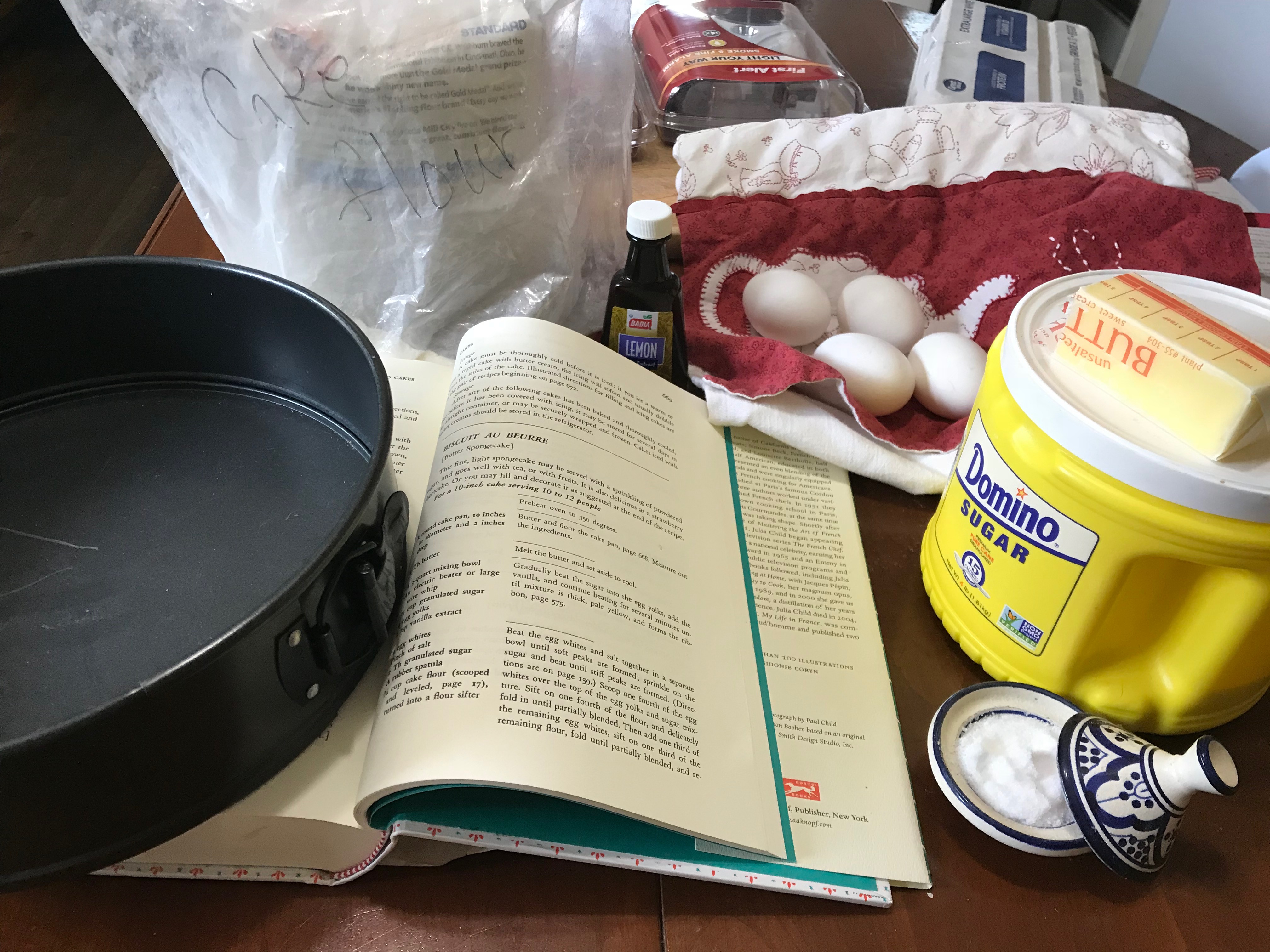
Cake Week: part two; Julia Child’s Biscuit au Beurre

Butter Spongecake from  Mastering the Art of French Cooking: this was chosen when I consulted this cook book about the size of pan to use. Julia uses a 10 inch pan for 4 eggs. In “Cake Week”: or my attempt at the sponge, part one I used 6 eggs in an 8-inch pan.  Julia tells the baker what equipment to use, balloon whisk and 10 inch pan. This recipe adds some butter. The other recipe choice I could have made was the Orange Sponge which uses 4 eggs in a 9 inch pan. Hopefully I will redeem myself with this Sponge.

  • 4 Tablespoons butter, melted and left to cool
  • 2/3 cup sugar
  • 4 egg yolks
  • 2 tsp vanilla extract
  • 4 egg whites
  • pinch of salt
  • 2 Tb sugar
  • 3/4 cup cake flour turned into a sifter
  • IMG_2020
    not quite as elegant a mise en place as in part one

Butter and flour a 10 inch round cake pan at least two inches deep. I use my 10-inch springform pan. I spray all around with baking spray. Perhaps I should have just sprayed the bottom and not the sides? This is a sponge recipe so the eggs are separated with the egg whites folded into the batter.

Gradually beat the 2/3 cup sugar into the egg yolks, add the vanilla and beat for several minutes until thick and pale and “forms the ribbon”.

Beat the egg whites and salt together in separate bowl until soft peaks form. Sprinkle on the sugar and beat until stiff peaks are formed.

The combining of these gets fussy. And I believe this affected the outcome.

Scoop 1/4th of the egg whites over the egg yolk mixture. Sift on 1/4th of the flour. “Delicately fold in until partially blended”. Repeat with 1/3 of the egg whites and flour. Repeat with 1/2 of each.  Then the last of each. When partially blended fold in the rest of the tepid butter but not the milky residue at the bottom. “Do not overmix; the egg whites must retain as much volume as possible.” Turn into the pan and bake at 350 degrees F (a proper temperature) for 30-35 minutes. Let rest in pan for 6-8 minutes and then turn out.

It was difficult not to add the milky residue. And I may have more fully blended than partially. The volume of the batter diminished slightly while adding the butter.

This cake did not rise. It did remain spongy though. I glazed it with a Lemon Marmalade as I had substituted one of the teaspoons of vanilla with one teaspoon lemon extract.

So did I redeem my place in “the tent”? I am not sure. I do not know what constitutes “a proper sponge”. But I do not think I will get a handshake from Paul!

Both cakes were spongy. The butter sponge was slightly more dense than the other but not quite as dense as an ordinary butter cake. The crumb looked good with even air bubbles. The first sponge was quite spongy. And its flavor was more enjoyable. The verdict is to remake the first cake using the 10 inch pan. Or maybe I’ll just stick to butter cakes.